Propagating Rare Spring Ephemerals in Shade
The life history of a woodland ephemeral is defined by a race against the forest canopy. For eight brief weeks in early spring, the temperature of the bare soil rises while direct sunlight reaches the forest floor unimpeded. Before deciduous trees close the canopy in late spring, ephemerals must break dormancy, open blossoms, secure pollination from early native insects, mature fruit, and channel starches back into underground rhizomes.
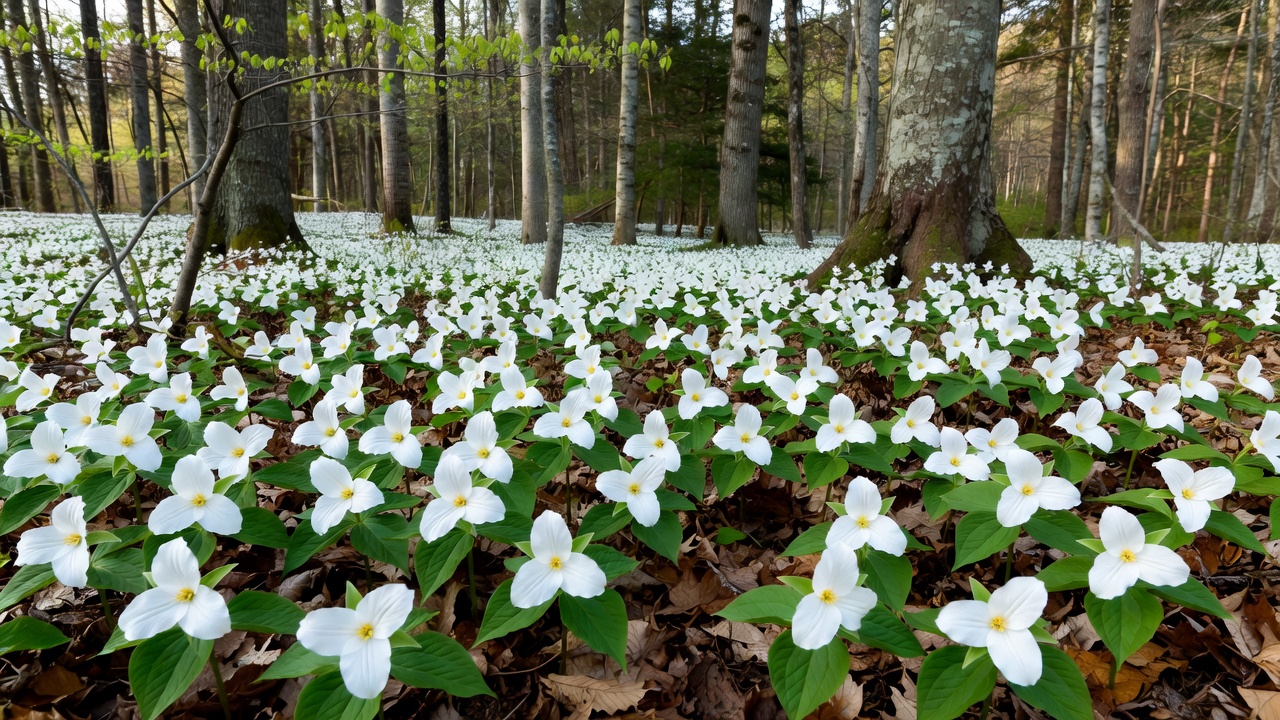
Ecological Pillars of the Vernal Groundlayer
1. Great White Trillium (Trillium grandiflorum)
Renowned for its pure white, 3-petaled corolla that fades to soft rosy pink as pollination completes. A single trillium seed can require two full cold-stratification winters before producing its first true green cotyledon leaf. Under undisturbed conditions, mature colonies live for over 40 years, forming dense drifts across mature deciduous woods.
2. Bloodroot (Sanguinaria canadensis)
One of the earliest flowers to emerge, often pushing through snow-dusted leaf litter. Each pearlescent white blossom is cradled by a scalloped, sea-green leaf that wraps protectively around the stem on cold mornings. The thick orange-red rhizomes contain the alkaloid sanguinarine, which deters destructive rodent tunneling.
3. Yellow Trout Lily (Erythronium americanum)
Recognizable by its mottled, trout-patterned foliage and nodding yellow lilies. Trout Lily colonies spread primarily via subterranean stolons called "droppers" that burrow deeper into the humus each season. An individual plant may take seven years of vegetative maturation before producing its initial single flower.
4. Virginia Bluebells (Mertensia virginica)
Originating in rich alluvial floodplains, Virginia Bluebells feature pink buds that unfurl into clear sky-blue trumpet clusters. By July, their large fleshy leaves have dissolved back into the soil, leaving empty gaps that should be underplanted with warm-season woodland ferns or late-blooming Asters (Symphyotrichum cordifolium).
Myrmecochory: The Ant-Seed Alliance
Unlike open prairie plants that depend on wind or bird ingestion for seed transport, over 30% of woodland forest floor species rely exclusively on ants—a biological partnership termed myrmecochory.
Seeds of Trillium, Sanguinaria, and Dicentra are capped with a nutrient-dense, lipid-rich packet called an elaiosome. Foraging ants transport the entire seed package into subterranean ant galleries, consume the lipid structure, and bury the intact seed within nutrient-rich refuse chambers beneath the duff layer, safe from seed predators and surface desiccation.
Propagation Protocols: Seed vs. Rhizome Division
Never wild-collect ephemerals from public forests; wild poaching has pushed species like Ginseng and Goldenseal into severe ecological distress. Instead, purchase nursery-propagated stock or collect mature seed from your own garden:
- Fresh Seed Sowing: Ephemeral seeds possess recalcitrant embryos. If seeds dry out in transit, they enter secondary dormancy or lose viability. Sow freshly harvested seeds immediately into flats of damp leaf mold outdoors.
- Autumn Rhizome Division: When ephemerals become overcrowded after 5–7 years, divide rhizomes during late-summer dormancy (late August to September). Replant sections 2 inches deep, orientation facing up, and cover with 2 inches of whole oak leaves.