Stratified Forest Canopies: Tall Oaks to Groundcovers
In an unmanaged climax forest, sunlight does not encounter bare earth. Instead, it collides with successive tiers of photosynthetic foliage, each adapted to harvest a precise wavelength and intensity of solar energy. By mimicking this vertical gradient in home gardens, landscapers replace the constant battle against weed colonization with a self-regulating microclimate.
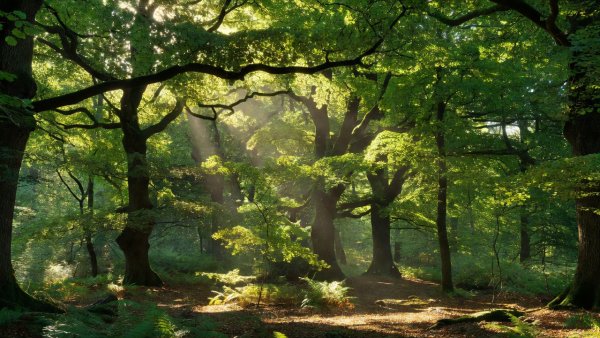
The Five Ecological Layers of the Woodland Garden
1. The Overstory Canopy (45–100+ Feet)
The dominant overstory forms the thermal and structural umbrella. Deciduous hardwoods such as White Oak (Quercus alba), Sugar Maple (Acer saccharum), and Sweet Birch (Betula lenta) intercept high summer sun, preventing extreme ground temperature fluctuations. Their extensive root architectures operate in deeper subsoil layers, drawing calcium, potassium, and magnesium into high-altitude leaves, which eventually drop as biological mulch.
2. The Sub-Canopy & Understory Trees (15–35 Feet)
Occupying the intermediate air space, understory trees flourish in diffuse solar conditions. Pagoda Dogwood (Cornus alternifolia) features distinct horizontal architectural branching, dispersing rain droplets into a gentle mist rather than heavy soil-eroding drops. Eastern Redbud (Cercis canadensis) provides early pink blooms that nourish newly wakened pollinators before larger trees unfurl their leaves.
3. The Woody Shrub Layer (4–12 Feet)
Shrubs create horizontal wind baffles, trapping leaf duff and preventing desiccating winter winds from stripping moisture from the root zone. Spicebush (Lindera benzoin) tolerates damp deep shade, producing aromatic foliage and high-fat autumn drupes for migrating thrushes. Oakleaf Hydrangea (Hydrangea quercifolia) thrives in dappled borders with dramatic seasonal peeling bark and bold foliage.
4. The Herbaceous Perennial Floor (6–24 Inches)
This level holds the highest biodiversity. Rather than relying on single-species monocultures of woodchips, an ecological woodland garden employs living root systems:
- Wild Ginger (Asarum canadense): Velvety, kidney-shaped leaves forming dense contiguous shade rugs.
- Pennsylvania Sedge (Carex pensylvanica): Fine-textured woodland graminoid that forms cascading golden hummocks in dry shade.
- Solomon's Seal (Polygonatum biflorum): Arching stalks bearing small bell-like flowers under each leaf node.
5. The Duff, Bryophyte & Mycelial Layer (Ground Level to 2 Inches Deep)
The forest duff is an organic sponge. Unshredded autumn leaves, rotting twigs, and native mosses (like Thuidium delicatulum, the Fern Moss) retain up to four times their dry weight in rainwater, slowly discharging it to subterranean roots during midsummer droughts.
| Canopy Stratum | Primary Functional Role | Key Representative Species | Light Absorption |
|---|---|---|---|
| Dominant Canopy | Thermal moderator, nutrient mining | Quercus alba, Acer saccharum | Direct / 100% full sun |
| Understory Trees | Rainfall baffle, vernal blooms | Cornus alternifolia, Amelanchier arborea | Filtered 40–60% |
| Woody Sub-Shrub | Wind break, micro-fauna shelter | Lindera benzoin, Viburnum acerifolium | Dappled 25–40% |
| Herbaceous Layer | Living green mulch, weed suppression | Carex pensylvanica, Asarum canadense | Deep shade 10–25% |
| Duff & Bryophyte | Moisture sponge, fungal mycorrhizae | Thuidium delicatulum, Polytrichum | Residual 5–10% |
Practical Implementation Sequence for Homeowners
When establishing a woodland planting in existing residential yards, avoid clearing the native soil profile. Begin by mapping existing root zones. Never till beneath the drip-line of mature oaks; tilling severs fine feeder roots situated in the upper six inches of humus. Instead, layer four inches of shredded autumn leaf mold over bare soil, plant nursery specimens directly into carefully notched planting holes, and immediately inoculate the interface with woodland spore teas.